Wednesday, December 19, 2007

Arak - Markazi Province

Arak's General information:
The City of Arak is in the southwest of the Markazi province. Arak has cold winters and moderate summers. It is the capital of the province and is 295 km far from Tehran. The city is one of the industrial poles of the country, almost the third important industrial city after Tabriz and Isfahan.


Arak - Mountain view

Arak's Neighborhood:
In the North of city you see Saveh, Tafresh and Komeijan. West meets Malayer and Shazand, East is facing Mahallat and Qom. In the south of Arak there are Khomein and Golpaigan cities.

Arak's Infrastructures:
As the main transportation infrastructure, the Tehran - Khuzestan railroad crosses this city. Also Tehran-Qom highway continues through Salafchegan to Arak city. All Mobile operators in Iran, (MCI, MTN Irancell and Taliya) are active in the city of Arak.

Arak - Haftad Gholleh District

Arak's Establishment:
The Arak city was established during the reign of Fathali Shah Qajar. At first this city was called "Qaleh Soltan Abad". In 1840 its name changed to Arak. Since its establishment till date Arak faced several changes. Until the early 1890 ,Arak was a military city and the base for generals. But from the time of Mirza Hassan Khan, the military status of the city reduced and gradually became a commercial and industrial city. Once the World War I broke out and the Qajar dynasty cracked down, Russian forces occupied Saveh, Soltan Abad, and the nearby regions. When the World War I and the political changes of the country ended, Soltan Abad also faced the changes of that time, and its physical appearance changed immensely. This process continued to the next decades. Presently, Arak is one of the important industrial cities of Iran.

Arak Nuclear Site:
Iranian heavy water nuclear site is placed in Arak city. The Arak nuclear reactor is a heavy water reactor for processing Platinum which Iran has always declared for peaceful purposes.


Arak's Heavy water nuclear plant

Universities of Arak city:
Arak University of Medical Sciences
Arak University of Science and Technology
University of Arak
Islamic Azad University of Arak
Tarbiat Moallem University of Arak
Payam-e-noor university of arak (Distance Learning)
Mashinsazi technological training center

Related website: اراک و کمیجان

Thursday, November 15, 2007

Bushehr city - Bushehr Province

History of Bushehr
Bushehr is a port located in south west of Iran by the Persian Gulf. Bushehr is one of the most critical trade and commerce points and zones in Iran regarding its accessibilities to Indian Ocean and world’s free water-ways. Nader Shah founded Bushehr in 1736 by. Before that, the smaller town located there was called Rishehr, and was the seat of the Nestorian Christian expansion of the 5th century. In 1763 the Persian ruler Karim Khan-e-Zand granted a company (called British East India Company) the right to build a base and trading post there. It was used as a base by the British Royal Navy in the late 18th century. Later in the 19th century, Bushehr, as I described earlier, became an important commercial port. Regrading its importance, I think, it was occupied by British forces in 1856, during the Anglo-Persian War. Bushehr surrendered to the British on December 9,
1856. It was occupied by the British again in 1915, the second time due to German intrigue, most notably by a person known as Wilhelm Wassmuss (I’m not sure about his name’s spelling!). In previous centuries, many Africans settled in Bushehr. Although there is no discernible linguistic influence from Africa in Bushehr, there are cultural and genetic influences. Actually the southern Iranian people are dark skin colored (like Hindus) and have a taste of Arab accent in their speaking language. But they speak and write Persian.

Goor e Dokhtar, Bushahr

Bushehr Handicrafts and Souvenirs
Bushehr’s most known handicrafts are Carpets, Kilim, Gabeh or a traditional form of carpet, felt, mats, baskets, Giveh or a local foot ware, brooms, earthenware, hookas, musk, fishing nets and sweet meat. Local Music and Dances, Bushehr The local music and dancing of this area is very similar to the Africans. The local anthems are traditional the most important of which are known as Sebalo, Shirveh and Yazleh.

Raiis Ali statue, Bushehr

Universities:
Bushehr University of Medical Sciences
Islamic Azad University of Bushehr
Iran Nuclear Energy College
Persian Gulf University

Persian Gulf Coast, Bushehr

Saturday, October 13, 2007

Abadan - Khuzestan Province

In the south west of Iran, in the Khuzestan province, where the sun warms your skin even in the middle of the winter, where the humidity can completely get saturated up to 100% with 60 Centigrades degree heat! there is a city: Abadan


Welcome to Abadan sign, in the international airport of Abadan

Abadan reminds all Iranian about things, nostalgically, the Karoun river which is the longest and the largest in Iran, which is the source of folkloric music of Bandari. this native and old kind of music is based on ragtime rhythm. But as a modern issue, Abadan reminds Iranian of oil, which is our main treasure. Oil was discovered in Abadan in 1908. Abadan also recalls the warm people living in it to me. Abadni people are really friendly, calm and smooth, easy going also.


two views from Karoun River
Abadan has nearly half a million population (2007) while it was dropped nearly to 10,000 people during the imposed war (Iran-Iraq). Abadani people are Persian and Arab but most of both parties are very patriot and nationalist.
Abadan is well-known for its refinery complex which was the largest in the region for years, but not now. also Abadan Institute of Technology AIT is very famous which is founded in 1939.

The city is still beautiful and attractive especially in winter time when the northern regions in Iran are pretty cold.


A night view of Abadan
Abadan has very good tourism facilities regarding the business attractions it makes for companies like hotels, airport and transportation services. Hotel Azadi (Parsian), Karevansara Hotel, Abadan Hotel and some others are samples of 5 or 4 star luxury ones.
You can go to Abadan on air from Tehran, Kish Island, Isfahan, Dubai and some other cities in Iran. Abadan has a train station also for passengers and general transportation. It's also just 80 minutes from Ahwaz by car.

Wednesday, September 05, 2007

Vegeterian

I am simply becoming a Vegetarian! If you ask me why, I have to say: half for spiritual reasons and half for my concerns about the world I live in. I think people are changing the world's nature. we are killing animals, destrying woods, warming the eart and ... changing the climate.
We kill lots of animals, but many people remain hungry and dying. This is a lose-lose game.

Friday, August 03, 2007

Zanjan city - Zanjan Province

Zanjan

Province and the City
Zanjan Province is located in North West of Iran (Persia). The province has been divided in two in 1996. Qazvin province formed by taking Qazvin and Takestan cities from Zanjan province and 7 other major cities/countries remained in Zanjan province: Zanjan, Abhar, Khorramdarreh, Tarom, Mahneshan, Eejroud and Khodabandeh.

Zanjan Grand Hotel

Zanjan is mostly an industrial province with its major industries in Automobile, Electrics, Metal works and Textiles. Iran Khodro, Iran Transfu Company, Iran Zinc Mines Development Company and Pars Switch are some samples of them.

Tourism and Economy


Zanjan has a great position in different kinds of Tourism like business tourism, Eco Tourism and historical sites tourism. There are many business & investment opportunities in the province for foreign investors and companies. Some of these fields are listed below: …
For tourists interested in historical sites and monuments Zanjan has many things to be visited. The most famous places among them are Rakhtshooi Khaneh (a place where people used to wash their clothes there), Soltanieh citadel tower and some Karevansaras (Places for travelers and ancient letter carriers, Chapars) etc.

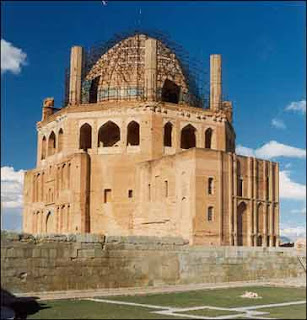
Soltanieh Citadel


Two Soltanieh Inside views
One of the most Significant points of Zanjan city, is Caspian Exhibition complex. Caspian is in the suburb of Zanjan, close to El Daghi complex. I think Caspian Exhibition can play a great role in Zanjan’s economy growth. Caspian is designed in 3 phases and right now (July 2007) the 1st phase is completed in three salons (1600, 3200 and 3600 Square meters) and the second phase is 40% completed. One the most important issues that Caspian suffers from, is car parking area for visitors.
Modern Zanjan

Nowadays, Zanjan city with a population of nearly half a million (1.2 million people the whole province) is almost a modern city in Iran but still with traditional culture and life style. I really felt the lack of entertainment facilities in the city, since the only places to get some rest for residents are El Daghi and Mellat complexes. There are two lakes in Zanjan which I really missed some Jet Skies and boats, but there isn’t any.

El Daghi Complex

Education

Today’s Zanjan is a good place for education. There are many universities in Zanjan and there are lot students from other cities especially from Tabriz and Tehran. Professor Sobouti, who is a Zanjani himself, has made a well equipped university for post graduation which is one the most beautiful and pleasure places I’ve ever seen as an academic center in Iran.


Post Graduate - Zanjan University (Prof. Sobooti)

Tuesday, July 03, 2007

Qom city - Qom Province

Qom is a religious city just 160 Km south west of Tehran, the capital of Iran. Since this city plays a great role in Iran’s governance, there is lots of attention on this city. Beside the modern attention, the city has an independent character regarding its culture and its influence on the whole country.
Qom is considered to be a holy city among Shia Muslims, as it is the site of the shrine of Fatema Masume, sister of Imam Ali ibn Musa Reza (789-816 A.D.). The city is the largest center for Shia scholarship in the world, and is a significant destination for pilgrims.


Shrine, Qom

I travelled to one of Qom’s suburbs last month to dig one of its most famous handicrafts known for Iranians and also for the whole world from Iran: The Blue beads!
The Original Blue Beads

The Blue Beads are known to be of good luck and bringing you the good things while they keep the curse and bad luck far from your fate. Those are all about superstitions of course, but the blue glaze on the beads, are welcome by most cultures by the way.
Making Blue Beads

Qom is the origination of blue beads since 1000 B.C. but nowadays we see Turkish handicraft makers claim Blue Beads are originated from their country, which is simply a false judgment regarding the most famous encyclopedia, Britannica.
A modern Islamic Blue Beads Handicraft

Tuesday, June 19, 2007

Dubai

Dubai is experiencing high construction plans and projects these days. There are still lots of halfway projects in Dubai: residential, trade zones, complexes and etc.

Maybe more than half of these projects are held by Iranian investors because they have found Dubai a safer place to invest in. It's a pity for Iran's Economy and I regret it, but Economy has been always proved itself as un-magisterial and logical.

As a result of this attention Dubai receives from constructors, this city is attracting retail investors' attention too. There are lots of Iranian rushing to buy a property in Dubai for the benefits and the scope of the future also. benefits like having a permanent residential VISA permission or ability to rent the house. Right now the rate of rent in Dubai is nearly 13 percent of the value of the property per year which is quiet good comparing with Iran's 7%.